Inside “Our Stories”: A Participant Perspective on the Training Course
Participants of the Erasmus+ training course “Our Stories” share their experiences, reflections, and learning journey from eight days of storytelling, youth work, and intercultural exchange in Druskininkai, Lithuania.
12/20/20255 min read
Erasmus+ Program has been important for the education and development of young generations across the European Union. For the ones that already got the chance to be part of one of the branches of it - youth exchanges, training courses, or voluntary actions, through the European Solidarity Corps -, there is no doubt: it allows us to learn everyday and meet new people from different countries, with different perspectives, backgrounds, and goals.
The Training Course “Our Stories” took place in the Lithuanian thermal town of Druskininkai, not too far from the border with Poland and Belarus, and in the middle of an astonishing natural scenario, painted with lakes and forest.
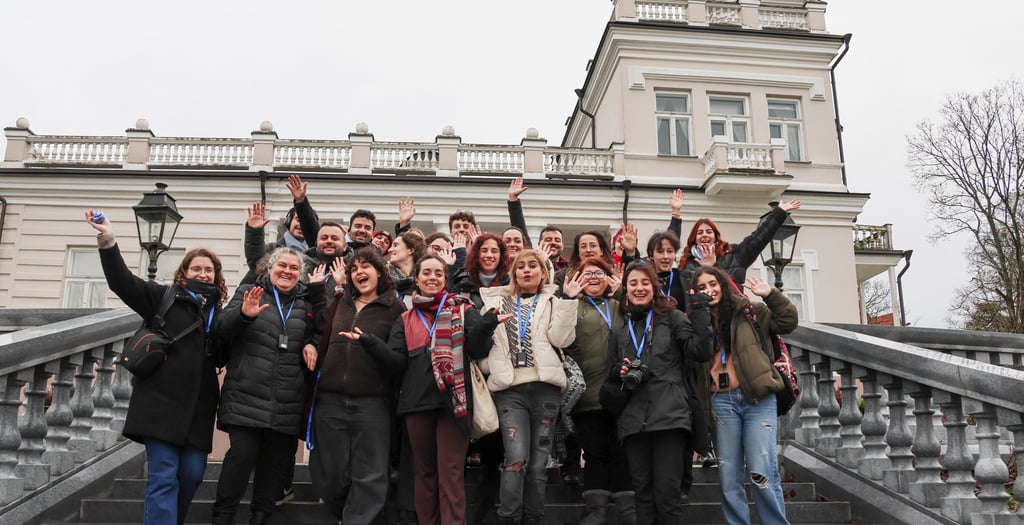
The nine days length course on storytelling for youth workers (8th-15th December, 2025) has allowed to smoothly connect a group of 24 newcomers from Lithuania, Italy, Romania, Portugal, Spain and Greece. On the one hand, through non-formal education and with a theoretical lens, the participants learned the basics of storytelling, creating plots with contemporary tools, and learned how to identify the main archetypes of a story. On the other hand, with a practical lens, they had the chance to not only give strong and meaningful messages in an adapted way for all types of audiences, but also develop interpersonal bonds.
The different backgrounds and experiences of each member is the perfect breeding ground to get access to an open perspective about all the questions that are raised by the hosts, as well as to share each others’ identities with the group. This way, everyone can learn from one another. Empathy, dialogue and communication are the pillars of teamwork, where every voice is heard and all the participants try to boost their weaknesses and consolidate their strengths.
Rebecca, for instance, is a future journalist and youth worker; for her, this training course has been the first of her life and helped to improve her extrovert character, while she took the lead in the writing practices and learnings on the moments where the group has to talk to the public. Chiara, in turn, is a curious language student and it became more clear to her that she can open herself to others when in a safe space, and she contributes to the team her hardworking spirit. For Eduardo, a charismatic person, he doesn't practice any artistic traits, such as painting or acting, but the training course was useful for him to consolidate his own strengths and gave him the chance to feel more secure with his weaknesses through the different activities the program offers. Nonetheless, he offered his voice and presence when the team had to present something publicly.
As of the final product of the project, the participants were invited to facilitate several sessions on storytelling and take the lead. Storycubes, visuals and story excerpts are just a few examples of what they could use to create stories to tell each other and reflect on our own past, present and future. And just in case you doubt, dare to look around, focus on your social network and your main occupation and ask yourself: “How can I tell my story?
Our days
Day 1: initial day
The first day was devoted to presenting the course and team building. We carried out activities aimed at getting to know each other better and, in groups, we created the course logo and a dance linked to it. During that day, we had the chance to get to know each other better, not only with our presentations but also with team building activities such as group games and laboratories.
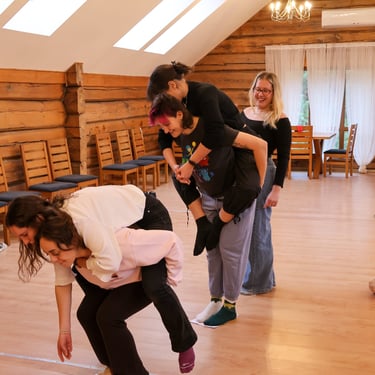
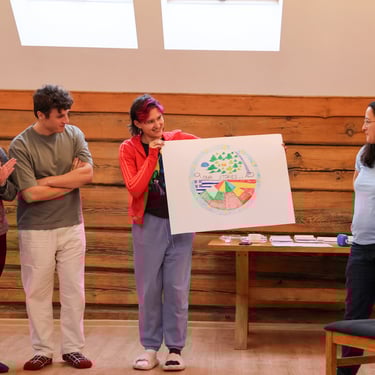
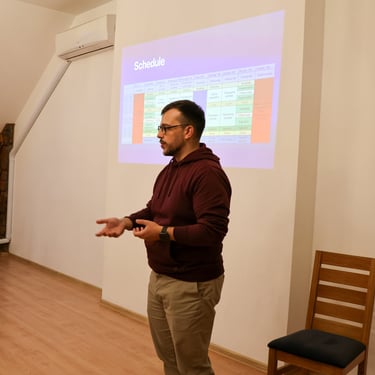
Photo 1: a moment from the Team Building Sekiony
Photo 2: a moment of the presentation of the activities during day 1.
Photo 3: Carlos’s presentation of the week
Day 2: introduction to the concepts
On the second day, we began to explore storytelling in greater depth: we started from a theoretical perspective, and suddenly after continued with practice sessions. We used different types of plots and archetypes: with the using of specific plots, archetypes and story cubes we invented our own stories and during the afternoon, we did an activity called ‘Humans as shared stories’ during which we had the chance to explore our human identity as a collection of stories, with plots, subplots, twists, and characters.
The last session of the day was “Stories and perceptions”: each group was assigned a story with the same characters but with slightly different dynamics, and the aim was to introduce the concept of framing, and to show how the inclusion, omission, or change in wording and details can alter the perception and understanding of a story.
We finished the day with the reflection on the day and during the evening we had the first of three cultural nights with Italy and Portugal teams.
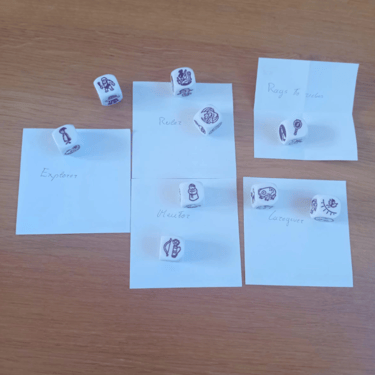
Photo 4: a moment of work with storycubes
Goals
Introduce the foundations of storytelling;
Bring everyone on the same page in terms of vocabulary and knowledge of the concepts used throughout the training;
To gain familiarity with storytelling.
Day 3: Stories and Societies
During the third day we explored the role stories play in the creation, reproduction and divulgation of societies. The first session, entitled ‘Societies as shared stories’ had the aim to show how human societies are bound together by a collection of stories about themselves and their relations to others, and to gain the ability to recognize and and influence them.
We then explored discourse strategy by watching a documentary and reframing it: the goal of this activity was to gain narrative awareness and to be able to identify and challenge the various discursive elements, as well as to use them to improve the communication process.
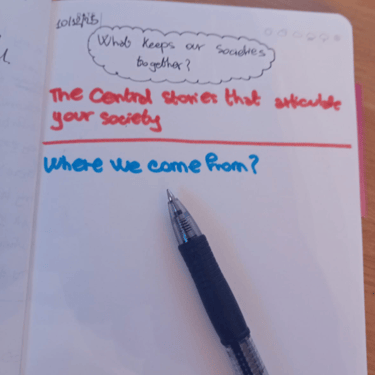
Photo 5: time to get some inspiration to talk about our societies
Day 4: storytelling in youth work
The fourth day was dedicated to storytelling in youth work. This day focuses on providing practical experience and knowledge on the application of specific youth work techniques and frameworks to daily youth work. The sessions were intended to clarify the practical applications of storytelling in youth work through the exploration of a focused discourse analysis and framing as a way of identifying, creating, reinforcing and the using narratives and discourses at play in the work with youth.
The session ‘Storytelling for exploring difficult topics’ focused on storytelling based facilitation, used as a tool to explore conflict, tackle difficult topics, gamify activities, reinforce learning processes with the goal to give to the participants a structured, non-personal framework for introducing and discussing sensitive social and personal issues in order to work with young people, ensuring emotional safety and perspective-taking.
We finished the day with the reflection on the day and during the evening we had the second of three cultural nights with Greece and Romania teams.
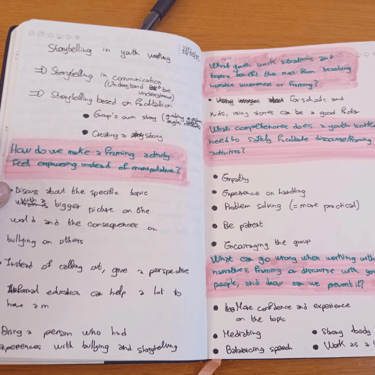
Photo 6: time for a quick brainstorming before speaking about storytelling in youth work.
Day 5: a day in Druskininkai
On the fifth day, we visited the Druskininkai Youth Centre and listened to the views of the educators and the centre's director.
Afterwards, we took a guided tour of the town and finally we were received at the town hall, where we were presented with the youth projects implemented by the municipality: during our meeting we found out the existence of Youth Voluntary Service Program, which involves and encourages youth from 14 to 29 years of age to take part to a 6-months period of volunteering.
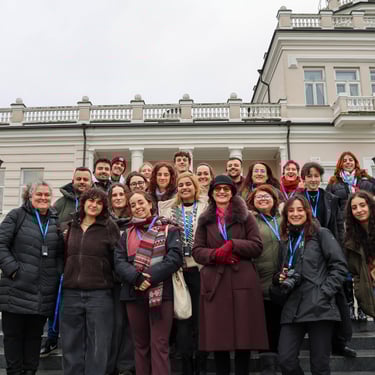
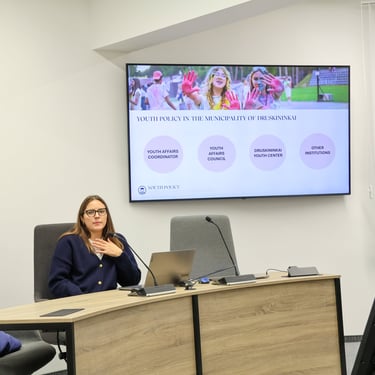
Photo 7: group picture in Druskininkai
Photo 8: the meeting at the Town Hall
Day 6 and Day 7: from theory to practice
The sixth and seventh days gave the opportunity to put into practice what we learned during the previous days. We finished the days with reflection and during the evening of the sixth day we had the last cultural night with Lithuania and Spain teams.
The sessions were implemented on actual topics like the environmental crisis and disabilities and team working; but also many creative ones such as storytelling about arts, motivational storytelling, creativity boost for storytelling and inside the story.
Written by the participants of the Erasmus+ training course "Our Stories".
Funded by the European Union. Views and opinions expressed are however those of the author(s) only and do not necessarily reflect those of the European Union or the European Education and Culture Executive Agency (EACEA). Neither the European Union nor EACEA can be held responsible for them.